
Why Is My Water Bill Suddenly So High?
You opened your water bill and nearly fell off your chair. Before you blame the council or your teenager, here are the six most common reasons your water bill spikes — and how to check each one.
The most common cause of a sudden high water bill is a hidden leak — usually a running toilet (6,000-15,000 litres/month wasted), a leaking irrigation system, a dripping outdoor tap, or an underground pipe leak. Check your water meter — turn off all water, wait 30 minutes, and see if the dial has moved. If it has, you have a leak. Compare your current usage in kilolitres against the same quarter last year to rule out rate increases. Most hidden leaks are cheap to fix if caught early and expensive if ignored.
- • Check your meter — turn everything off, wait 30 min, see if the dial moved.
- • Running toilet is the #1 hidden culprit — check the flapper valve in the tank.
- • Irrigation faults — walk the garden during a cycle and look for gushing heads or puddles.
- • Outdoor taps and hoses — a slow drip wastes 500-1,000 litres per day.
- • Compare usage (kL) against last year — not the dollar amount — to rule out rate changes.
- • Call a plumber if you cannot find the source — hidden leaks cost 10x more to repair later.
6 causes of a high water bill
Each cause includes a specific sign to check. Go through them in order — start with the meter test, then work through the others before calling a plumber.
Undetected water leak (most common)
A hidden water leak is the #1 cause of a sudden high water bill. A slow drip from a pipe under the slab, behind a wall, or in the garden can waste 10,000-50,000 litres per month without any visible sign. If your bill is 30-50% higher than normal with no change in household usage, you almost certainly have a leak somewhere.
How to check: Check your water meter: turn off all taps and appliances, note the meter reading, wait 30 minutes without using any water, then check again. If the dial has moved, water is flowing somewhere it should not be.
Running toilet (silent leak)
A toilet that runs intermittently is one of the most common hidden water wasters. The flapper valve wears out and allows water to trickle from the tank into the bowl without flushing. This silent leak wastes 6,000-15,000 litres per month. You may not hear it running — sometimes the leak only happens after the toilet has been unused for a while.
How to check: Remove the toilet tank lid and check. If the water level is at or above the overflow tube, or if you see ripples on the water surface when the toilet has not been used, the flapper is leaking.
Irrigation system fault
On the Northern Beaches, where many homes have automatic irrigation systems, a broken sprinkler head, split pipe, or stuck valve can waste enormous amounts of water unnoticed. If your irrigation runs at night, you may never see the leak. A single broken sprinkler head can waste 1,000 litres per hour.
How to check: Walk your garden during an irrigation cycle. Look for low-pressure areas, gushing heads, puddles forming, or zones that do not shut off completely. Check for water running down the driveway or footpath.
Leaking outdoor tap or hose
A dripping outdoor tap or a hose fitting that does not seal properly wastes water continuously. If you leave a hose connected with a slight drip, it can waste 500-1,000 litres per day — especially on properties with high water pressure, which is common on the Northern Beaches.
How to check: Check all outdoor tap fittings. Turn each tap on and off, watch for drips at the spout and at the handle stem. Disconnect hoses and check the tap washer. A tap that drips when fully off needs a new washer.
Rate increase or billing error
Sometimes the problem is not usage — it is the bill itself. Sydney Water rates typically increase each July. Your bill may also include a one-off charge, a previous under-estimate being corrected, or a meter reading error. Compare your usage in kilolitres (kL) — not the dollar amount — against the same period last year.
How to check: Compare the usage (kL) on your current bill to the same quarter last year. If usage is similar but the cost is higher, it is a rate or fee change. If usage has jumped significantly, you have a leak or a reading error.
New occupant or changed habits
A teenager home on school holidays, a house guest, or a new baby means more showers, more laundry, and more dishwasher loads. If someone is now working from home who previously commuted, daily water use increases. These changes are often gradual enough that you do not notice the bill creep.
How to check: Look at the daily usage graph on your Sydney Water bill. If the increase is consistent across all days (not a sudden step-change), it is probably a usage change. If there is a sudden jump on a specific date or a continuous upward trend, it is more likely a leak.
What you should do first
Do the 30-minute meter test before anything else. If the meter does not move, your problem is not a leak — check for rate changes or usage pattern shifts. If the meter does move, isolate the cause by turning off individual isolation valves (toilet, laundry, garden) and rechecking the meter after each one. When you identify the leaking circuit, call a plumber for that specific issue.
For Sydney Water customers on the Northern Beaches, you can also log in to the Sydney Water portal and view your daily water usage graph. A sudden vertical jump on a specific date often correlates with a pipe burst or irrigation fault. A gradual upward trend over a month suggests a running toilet or dripping tap.
When to call a plumber
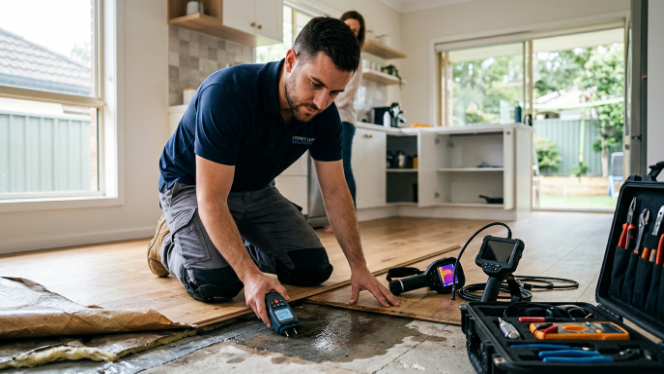
Call a leak detection specialist if the meter test confirms water is flowing but you cannot find the source. Hidden leaks behind walls, under concrete slabs, or in underground pipes require electronic detection equipment — acoustic listening devices, thermal imaging cameras, and tracer gas systems. We use all three and can usually pinpoint the leak within 30 minutes of arrival.
If you have confirmed a leak and repaired it, keep the plumber\'s invoice — you can claim a leak adjustment from Sydney Water to recover the excess usage charges. We provide detailed invoices specifically formatted for Sydney Water adjustment claims.
Northern Beaches considerations
High water bills on the Northern Beaches have some local patterns. In coastal suburbs like Manly and Balgowlah, the most common cause is irrigation system faults — these suburbs have many established gardens with automatic watering systems that develop leaks over time. A split pipe from a stray gardening tool or a valve that sticks open can waste thousands of litres before anyone notices.
In older suburbs like Mosman, where many homes were built on reactive clay soils, underground copper water pipes can develop pin-hole leaks from ground movement. These leaks are almost impossible to detect without electronic equipment because the water seeps into the surrounding soil rather than surfacing. The only sign is a higher bill and a patch of unusually lush lawn.
Properties with high water pressure — common on the Northern Beaches due to Sydney Water\'s mains pressure in elevated suburbs — are more prone to leaking taps and toilet flapper valves. If your pressure is above 500 kPa, consider installing a pressure reducing valve to protect your plumbing system and reduce water waste.
Frequently asked questions
How do I test whether I have a water leak?
Turn off all taps and water-using appliances (washing machine, dishwasher, irrigation). Go to your water meter, lift the lid, and write down the reading. Wait 30 minutes without using any water. If the meter has moved at all, water is flowing somewhere. For a more sensitive test, watch the small flow indicator dial (usually a small triangle or star on the meter face) — if it is spinning even slowly, you have a leak.
Will my water bill be adjusted if I had a leak?
Sydney Water offers a leak adjustment for residential customers who have repaired a leak. You typically need to provide a plumber's invoice showing the repair. The adjustment covers the excess water usage charges (not the fixed service charges) for the period of the leak. Apply within 60 days of the repair for best results.
How much does leak detection cost on the Northern Beaches?
Leak detection services range from $150-$400 depending on the method used. Simple visual inspections and meter tests are at the lower end. Electronic leak detection using acoustic sensors or thermal imaging cameras costs $250-$400. We deduct the detection fee from the repair cost if you proceed with us for the fix.
Can a hidden leak cause structural damage?
Yes — and this is the real risk. A hidden water leak under a concrete slab or behind a wall unmarked for months can undermine foundations, rot timber frames, and attract termites. The water damage repair cost is typically 10-20 times the cost of finding and fixing the leak early. If your bill is high and you cannot find the source, call a plumber promptly.
High water bill? Let us find the leak.
We use thermal imaging and acoustic leak detection to find hidden water leaks fast. Same-day service across the Northern Beaches. Call now or book online.
Related reading
- How Plumbers Find Hidden Water Leaks— The technology plumbers use to find leaks without digging up your yard.
- Water Leaking Through the Ceiling? Do This Now— If the leak is visible rather than hidden.